
Categories List
When does a hobby desktop mini CO2 laser outperform a diode laser?
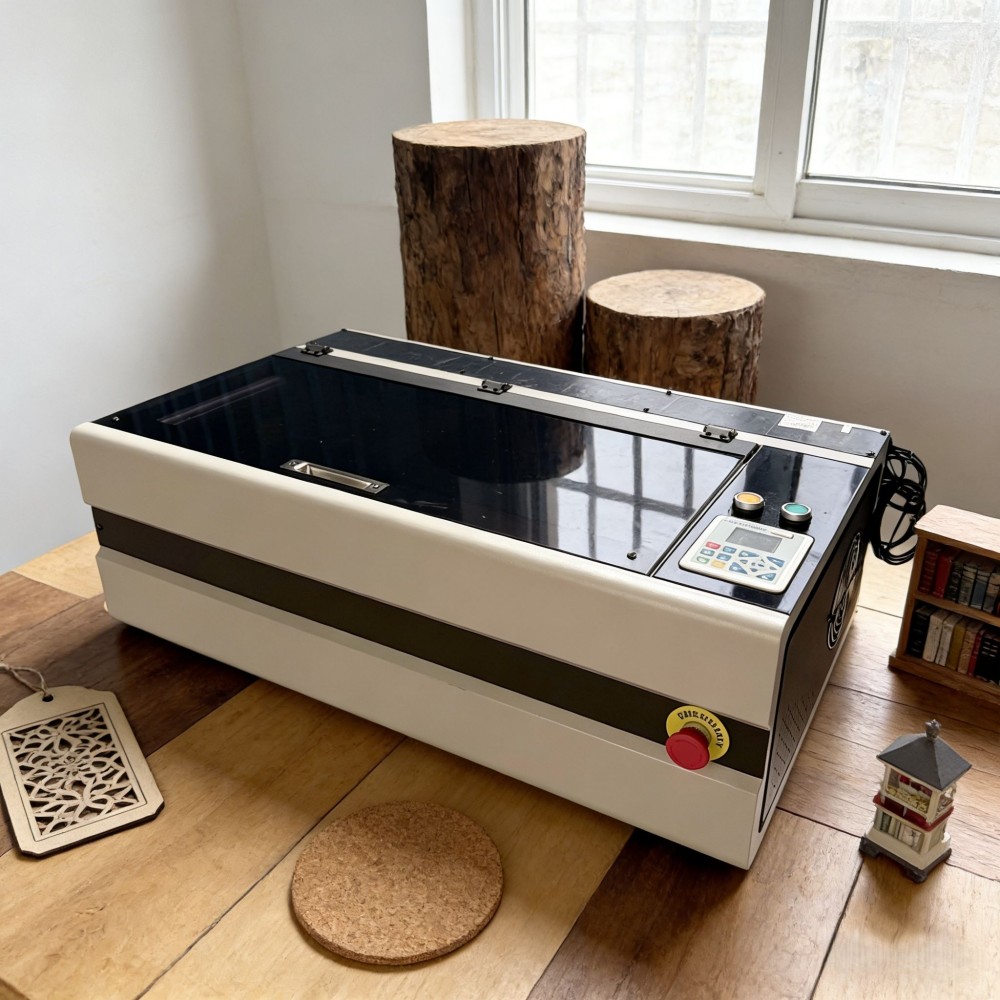
A hobby desktop mini CO2 laser outperforms a diode laser when the work repeatedly exposes the limits of visible-light laser absorption: clear acrylic cutting, glass marking, fast wood production, leather engraving, and thicker organic sheet cutting. The advantage is not simply a higher power number on a product label. A CO2 tube emits infrared light at a wavelength that couples efficiently with many non-metal materials, while a diode laser emits visible or near-visible blue light that interacts very differently with each surface.
For occasional engraving on dark wood, coated metal, cardboard, or painted surfaces, a diode machine can remain practical. Once the project requires clean, repeatable cutting across a broader mix of acrylic, wood, leather, rubber, glass, and fabric, a compact CO2 machine usually offers a more capable process window.
Material compatibility changes the decision
Clear and translucent acrylic are among the clearest dividing lines. A blue diode beam can pass through clear acrylic with little usable absorption, so increasing dwell time often does not create a reliable cut. A CO2 laser is absorbed strongly by acrylic, allowing it to engrave frosted designs and cut edges with a flame-polished appearance when focus, air assist, and speed are correctly balanced. Colored acrylic is not automatically easier for a diode laser; the pigment, transparency, and backing all affect whether the beam couples with the sheet.
Glass is another material where a hobby desktop mini CO2 laser has a substantial functional advantage. CO2 energy heats the glass surface sufficiently for controlled micro-fracturing, which produces a visible frosted mark. The result still depends on glass composition, curvature, and support, but the process is established. A diode laser generally needs a coating or marking compound to create a visible result on bare glass, adding preparation and cleanup while reducing repeatability.
Wood does not produce such a simple answer. Both technologies can engrave and cut many wood products. A diode laser may leave a narrow engraved line because its focused spot can be small, which is useful for fine images and small lettering on suitable surfaces. A CO2 laser normally gains ground when cutting speed, depth, and edge consistency matter. On plywood, the adhesive layers and voids can interrupt either process, yet the CO2 machine is more likely to retain enough cutting capacity to complete a design without excessive slow passes.
Cutting performance is governed by energy delivery, not rated power alone
Comparing advertised optical wattage without examining the beam path leads to poor machine selection. A diode module concentrates its output through a lens system and often achieves a small focal spot, but it has limited ability to deposit energy deeply into materials that do not absorb blue light well. A CO2 laser uses mirrors and a focusing lens to deliver infrared energy. Its focused spot may be larger than that of a fine diode module, yet it often removes material faster because the target absorbs the wavelength more effectively.
A practical test is to look beyond whether a sample can eventually be cut. Slow multi-pass cutting can leave a dark, wide kerf, a rough underside, and heat staining around small details. It also amplifies small flatness errors: a sheet that rises slightly at one corner may move out of focus enough to fail only in that area. A CO2 laser is the stronger choice when production requires a useful speed margin instead of operating at the edge of the machine's capability.
That margin matters on nested parts. A dense acrylic layout can accumulate heat when adjacent contours are cut in sequence. CO2 power permits faster movement and better path planning, reducing local heating and the chance that small parts shift after their holding tabs weaken. It does not eliminate the need for proper settings. Excessive power or insufficient air assist can still cause flare-ups, melted acrylic edges, or soot on wood.
Engraving quality depends on the image and the material
CO2 engraving excels at filled logos, broad lettering, texture removal, and frosted effects on acrylic or glass. It can raster larger areas efficiently and produces visible contrast on many woods without a coating. Leather work also benefits from the faster removal rate, provided the material is verified and the smoke extraction is adequate.
A diode laser can remain competitive for detailed line work on dark materials. The narrow spot may resolve delicate vectors that look soft when a CO2 lens has a larger spot size. This is why a machine chosen mainly for miniature line art does not automatically need to be CO2. The decision shifts toward CO2 when that same workbench must also cut acrylic components, mark glassware, or process larger engraved panels in a reasonable cycle time.
Resolution settings should not be treated as a quality control by themselves. Setting extremely tight line spacing on wood can overheat the surface, flatten natural grain contrast, and produce a muddy dark field. On acrylic, overlapping raster lines can melt rather than cleanly vaporize the surface. Material tests need to vary power, speed, focus, and line interval together; changing only power rarely identifies the source of a poor result.
Desktop CO2 ownership has operational requirements
The stronger material range of CO2 technology comes with a more involved machine setup. A tube-based desktop laser requires optical alignment, mirror cleanliness, a correctly focused lens, cooling, and dependable exhaust. Poor alignment can make a nominally powerful machine cut weakly on one side of the bed. A dirty lens absorbs heat, loses transmission, and can be damaged. These conditions can resemble a failing tube, so replacing the tube before inspecting the optics is a common and expensive misdiagnosis.
Cooling deserves particular attention. Air-cooled compact designs reduce plumbing complexity, while many CO2 desktop systems use water cooling around the tube. In either arrangement, stable operating conditions matter more than briefly achieving a high output setting. Extended cutting runs generate heat, and repeated operation outside the intended cooling range shortens component life and makes results drift between the first and last sheet.
Diode systems are mechanically simpler: there are no alignment mirrors and usually no separate tube-cooling circuit. Their maintenance burden is lower, although lenses, protective windows, belts, bearings, and air-assist hardware still need inspection. The trade-off is that simplicity does not solve wavelength-related material limitations.
Workspace and extraction can outweigh laser type
A CO2 desktop machine often has an enclosed work area, which helps contain light and smoke, but enclosure alone is not sufficient. Acrylic fumes, wood smoke, adhesive vapors, and leather odors need extraction that actually moves contaminants outdoors or through an appropriate filtration arrangement. A weak fan can leave residue on mirrors and lenses, reduce engraving contrast, and contaminate the machine interior.
The material itself must be known. PVC, vinyl, and unknown chlorine-containing plastics must not be laser processed because hazardous and corrosive gases can be released. Suspect coated sheets, imitation leather, foam, or recycled panels should be identified before testing. A clean-looking cut does not establish that a material was suitable.
Focus control also affects which compact machine is productive. A fixed-focus diode setup may work well on flat, thin pieces. CO2 projects involving thicker wood, curved glass, or varied stock benefit from an adjustable bed or a repeatable height-setting method. When every job begins with improvised shims, variation in focus becomes a hidden source of rejected parts.
Where a diode laser remains the better fit
A diode laser remains a sound choice when the material range is narrow and compatible with blue-light absorption, cutting is light-duty, and minimal maintenance is more valuable than throughput. It can also suit portable or open-frame workflows where an enclosed CO2 cabinet would be too large, provided proper eye protection, fire control, and fume management are in place.
It is also reasonable to keep a diode machine for high-detail marking while using CO2 for cutting and broader material processing. Similar terminology can obscure major technology differences in adjacent laser equipment: a Portable Air Cooled Handheld Laser Welding Machine 4 in 1 is intended for metal joining and related operations, not for replacing a CO2 or diode engraver on acrylic, wood, or glass. Laser source type must match the process rather than the general label of “laser machine.”
Choose a hobby desktop mini CO2 laser when acrylic and glass are regular materials, cutting speed affects the workflow, or the job mix demands enough reserve capacity to maintain clean results across wood, leather, and sheet goods. Choose a diode laser when fine engraving on compatible surfaces and a simpler setup outweigh those broader cutting and material advantages.
Leave A Reply
Get real-time quotes
Interested? Leave your contact details.